


This post is written by Russell Smith & Lee Cooper
Over the past 30 years, one question comes up consistently across every type of federal contractor we work with: how much does it cost to prepare a proposal?
The old rule of thumb — that proposal preparation cost runs about 2% of the contract value, is still cited, but it no longer tells the full story. RFP complexity, page limits, solicitation type, and your internal philosophy around PWIN (probability of win) all drive costs in ways that a single percentage can’t capture.
What we can offer is something more useful: a practical cost framework built around the four proposal types that account for the majority of federal solicitations, along with the variables that push costs up or down within each one.
Why Proposal Preparation Cost Varies So Widely
Before breaking down costs by proposal type, it helps to understand what actually drives variation in the first place.
Finally, B&P (bid and proposal) cost recovery plays a role in how contractors account for this spending. Under FAR 31.205-18, B&P costs are allowable as indirect costs, meaning you recover them across your contracts rather than charging them to a specific job. Understanding this framework helps put the investment in perspective — it’s not pure overhead.
The Four Proposal Types and Their Cost Profiles
Federal solicitations aren’t monolithic. The cost to prepare a proposal looks very different depending on what the government is buying. Here are the four types that collectively cover the majority of federal requirements.
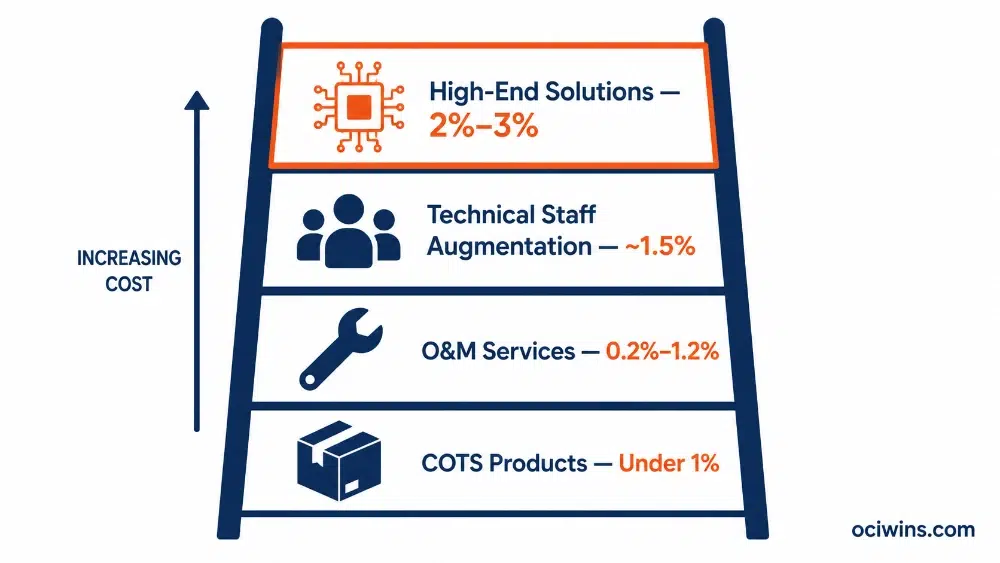
1. Base-Level O&M Services “0.2% to 1.2% of Contract Value”
Operations and maintenance proposals, grounds maintenance, building services, uniformed guard, utilities, trash collection, street maintenance — sit at the lower end of the cost spectrum. But “lower end” still covers a wide range.
At the minimum, a simple solicitation asking only for key personnel resumes and past performance can be put together for as little as two-to-three tenths of one percent of contract value, especially if the bidder has strong templates and has competed for similar work before.
At the higher end of this range, a complex O&M procurement requiring a management plan, transition plan, quality assurance plan, financial volume, and risk section can push toward 1.2%. The differentiator is solicitation requirements, not the service category itself.
Key cost drivers for O&M proposals:
- Number of required plans and volumes
- Transition complexity (incumbent vs. new entrant)
- Key personnel requirements
- Whether the bidder has reusable content from prior similar bids
2. High-End Technical and Engineering Services “~1.5% of Contract Value”
Staff augmentation proposals, where the government is buying a team of contractor personnel to provide on-site technical or engineering support, sit in the middle range. The bidder isn’t designing a system; they’re assembling and presenting a team.
That said, these proposals are rarely simple. Typical requirements include multiple key personnel with specific credentials, complex process descriptions, tools and metrics selections, reporting format specifications, and management approach narratives. The cost to prepare a proposal at this level runs around 1.5% of contract value, though solicitation complexity can push it higher.
The investment case here often comes down to PWIN. If you have a strong incumbent advantage or a clearly differentiated team, spending toward the top of the range to present that story compellingly is usually worth it. If you’re a long-shot bidder, the calculus is different.
Not Sure What Your Next Proposal Should Cost?
Our consultants have reviewed over 6,000 federal proposals. We’ll help you size your bid investment, assess your PWIN, and build a proposal strategy that makes every dollar count
3. High-End Solutions Proposals “2% to 3% of Contract Value”
Hardware and software solution proposals are the most expensive to prepare, and for good reason. The government is asking the contractor to design and price a complete integrated solution, which means the proposal isn’t just a written document, it’s the output of a real engineering and architecture process.
System architects and solution engineers typically develop the technical approach from scratch to address the customer’s specific problem. That solution development work, distinct from the proposal writing itself, is what drives costs into the 2–3% range.
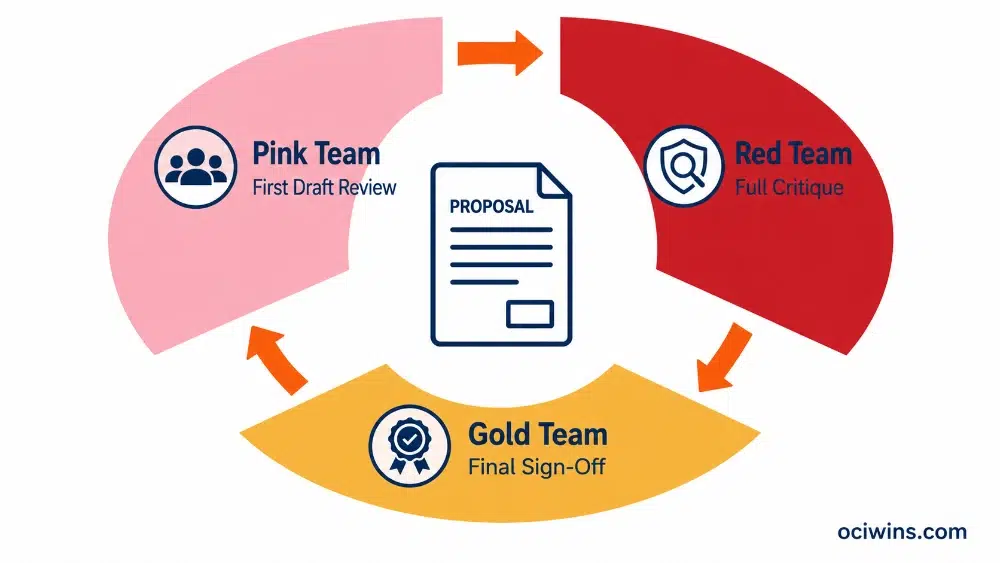
These proposals also tend to have the most complex review requirements. Multiple color team reviews (Pink, Red, Gold), proposal graphics that illustrate technical architecture, and extensive cost/price volumes all add labor hours. The page limits on these solicitations are often tighter than on simpler bids, which means the compression and editing work is substantial.
For high-end solutions bids, the bid/no-bid decision is critical. At 2–3% of contract value, a poorly targeted bid is an expensive mistake. Before committing to this level of investment, teams should be honest about PWIN and whether the opportunity aligns with their actual technical differentiators.
4. Product Proposals (COTS) “Fraction of 1%”
Commercial off-the-shelf product proposals are the least expensive category. The government is buying products with defined form, fit, and function, not custom development, so the proposal effort is relatively contained.
Basic product proposals can be prepared for well under one percent of contract value. What pushes costs up within this category is the scope of required services that accompany the product: warranty terms, maintenance programs, training, help desk support, configuration, and installation all add complexity to what might otherwise be a straightforward submission.
What Drives Proposal Cost Higher Than You’d Expect
Even within these ranges, specific factors consistently push proposal preparation costs toward the upper end. Knowing them in advance helps teams budget more accurately.
A Practical Framework for Budgeting Proposal Costs
Based on 30 years of experience across thousands of federal proposals, here is the framework we use when helping contractors think through proposal budgeting:
| Proposal Type | Typical Cost Range | Primary Cost Drivers |
|---|---|---|
| Base-level O&M services | 0.2% – 1.2% of contract value | Number of required plans, transition complexity |
| Technical/engineering staff augmentation | ~1.5% of contract value | Key personnel requirements, process complexity |
| High-end hardware/software solutions | 2% – 3% of contract value | Solution development, color reviews, graphics |
| COTS product proposals | Under 1% of contract value | Service scope (warranty, training, installation) |
These ranges assume a reasonably competitive bid. Proposals where you have a strong incumbent position or a uniquely differentiated solution may justify spending toward the top of the range. Proposals where PWIN is low and strategic value is limited should be budgeted conservatively, or not pursued at all.
Reducing Proposal Costs Without Sacrificing PWIN
There are legitimate ways to reduce the cost to prepare a proposal without compromising your competitive position.
The Bid/No-Bid Decision and Proposal ROI
One of the most valuable things a contractor can do to manage proposal costs is invest seriously in bid/no-bid decisions before committing to a response. The math is straightforward: if your PWIN on a $10M contract is 15%, your expected return on a $150,000 proposal investment is $1.5M in contract value. If your PWIN is 60% on the same opportunity, the same investment returns $6M in expected value. The proposal cost hasn’t changed — the strategic logic behind it has.
Teams that treat every RFP as worth responding to end up spreading their proposal budget across too many bids and rarely investing enough in any single one to truly compete. A smaller number of well-funded, strategically selected bids consistently outperforms a high-volume, low-investment bidding strategy.
The B&P budget conversation should happen at the capture stage, not after the RFP drops. By the time the solicitation is issued, the opportunity to shape your approach, and size your investment accordingly, is largely gone.
Frequently Asked Questions
Not Sure What Your Next Proposal Should Cost?
Our consultants have reviewed over 6,000 federal proposals. We’ll help you size your bid investment, assess your PWIN, and build a proposal strategy that makes every dollar count
Final Thoughts
The cost to prepare a government proposal isn’t a single number — it’s a range shaped by what the government is buying, how complex the solicitation is, how much you’re willing to invest to win, and how efficiently your team operates.
The 2% rule of thumb is a starting point, not a budget. The real discipline is in matching your proposal investment to your PWIN, your strategic priorities, and the actual requirements of each solicitation.
If your team needs support developing and pricing a competitive response, or wants experienced proposal consultants who can help you build a smarter bidding strategy, OCI has supported over 6,000 federal proposals across every major agency and contract type
Note
Lee Cooper is a senior business development consultant who previously served at the Senior VP level at Raytheon, Unisys, and other major defense contractors.


